A Jewish Reading of Magnifica Humanitas


The first encyclical of Pope Leo XIV is a message for all of humanity, as can be seen in its analysis of burning issues that commonly challenge all human beings. He himself expresses his desire to “enter into dialogue with all men and women of our time” (§2). He emphasizes this in §§219-223 where he speaks of the urgency of a dialogical approach for the improvement of human life. Echoing this perspective, I wanted to offer my first impressions of Magnifica Humanitas, a text that deserves much analysis and deep study.
The Pope uses two important biblical sources to frame his ideas: the story of the Tower of Babel (Genesis 11:1-9) and the reconstruction of the walls of Jerusalem by Nehemiah (Nehemiah 1-6). From the viewpoint of the Jewish-Catholic dialogue, I thought to compare Pope Leo’s development of these two biblical sources with rabbinic commentaries on them.
With regard to the Tower of Babel, we find rabbinic texts that understand the narrative in a way that is strikingly similar to how it is presented in the encyclical. In b. Sanhedrin 109a, the rabbis ask what was the transgression committed by the inhabitants of Babel in building the tower? Their conclusion is that the builders’ efforts amounted to no more than the construction of an idol.
Likewise, Rabbi Obadiah Sforno (Italy, 15th-16th century CE) explains that the tower, in its magnificence, would be tantamount to a domineering “deity” to which all of humanity would pay homage. Furthermore, whoever reigned in that city would rule over all humankind since everyone who wished to honor the supreme “deity” would have to journey to the tower (Sforno's Exegesis on Genesis 11:4).
In Pirkei DeRabbi Eliezer (Chapter 24), a pseudepigraphical Midrash from the 8th century CE written in the Land of Israel, we read:
There were no stones there to use to build the city and the tower. What did they do? They baked bricks and burnt them like a builder (would do), until they built it seven measures high, and it had ascending paths on its east and west. (The labourers) who took up the bricks went up on the eastern (path), and those who descended went down on the western (path). If a man fell and died they paid no heed to him, but if a brick fell they sat down and wept and said: “Woe is us! When will another one come in its stead?”
It follows from these readings of the Babel story that pagan idolatry leads to the dehumanization of individuals, as Pope Leo develops in his encyclical. Science and technology are meant to serve people, but when people value them more than their fellow humans, science and technology become destructive idols.
The reconstruction of the walls of Jerusalem in the times of Nehemiah was meant to guard a city inhabited by Jews who were dedicated to the worship of God alone. The Talmud indicates that during the Second Temple period there was no longer any pagan worship in Judea (b. Yoma 9b). Nehemiah 5 shows the connection between devotion to the One God and the commitment to lift the exploited needy out of their condition of misery.
Again, there are parallels with the encyclical’s emphasis on human dignity. This is unsurprising since Jews and Christians both deem the books of Genesis and Nehemiah to be canonical scriptures, thus testifying to the closeness of our two traditions.
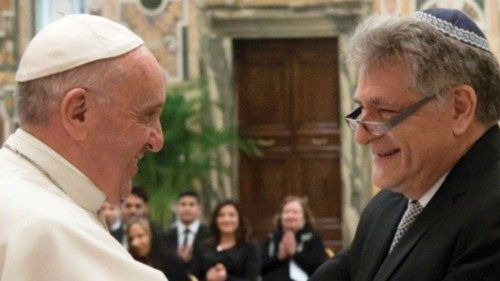
I might add that the biblical story of the Tower of Babel was a highly significant text in the conversations I had with Pope Francis. In 2010, when we dialogued about God as we were shaping the first chapter of On Heaven and Earth, the analysis of this story occupied a central place. He brought up the topic again in one of our last conversations when he expressed his concern about the advancement of artificial intelligence. I discern Francis’s anxiety throughout Magnifica Humanitas.
For some years now, Jews, Christians and many others are working together to keep AI focused on the service of humanity. Everyone who has such concerns are indebted to Pope Leo for bringing this issue to the attention of the world in such a comprehensive and profound first encyclical.
Abraham Skorka Georgetown University, Washington D.C.
Article published on June 3rd, 2026, in the Italian edition of L'Osservatore Romano.


Comments