Francis in History

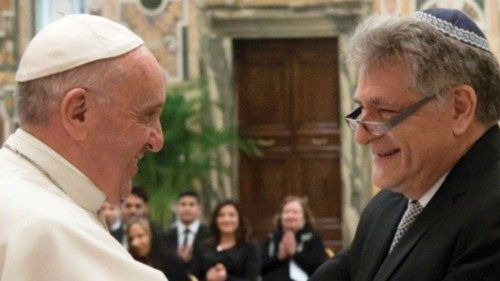
Much has been written about Jorge Mario Bergoglio as a person, a priest, and the Pope of the Catholic Church. Even more will certainly be written and researched, further shaping the image with which he will be remembered in history. Having had the privilege of forming a sincere friendship with him, I believe that the first anniversary of his passing is an opportune time to share some reflections and facts about the 266th Roman Pontiff.
Our dialogue was never restricted or limited in any way. It remained fluid, both personally in Rome and through a continuous exchange of letters. We didn't always agree on various topics, but our loyalty and brotherly bond were never diminished. He himself leaves an affectionate testimony to the unwavering feeling that united us in chapter 19 of his last book, Hope: The Autobiography. The dialogue we had developed over decades, which shaped the text of On Heaven and Earth and the television programs Bible: A Current Dialogue, remained forever unbroken, as did the feeling that bound us together.
In the dark days of the war between Hamas and Israel, our conversations touched on very sensitive topics. We always listened attentively and respectfully to each other's arguments.
He had a very special affection for the Jewish people. He demonstrated an extraordinary commitment to the fight against antisemitism. Faced with expressions of hatred against Jews, both in Argentina and around the world, his reaction was always immediate and forceful. These assertions do not stem from subjective opinions but is based on conclusive documents.
I accompanied him on his visit to the Holy Land. His vision for a peaceful solution to the Israeli-Palestinian conflict was through the coexistence of two states that respect each other. He expressed his empathy for the suffering of the Palestinian people by placing his hands in prayer on the wall that divides Palestinians and Israelis. Furthermore, he was the first Pope to honor the memory of Theodor Herzl, the founder of the modern Zionist movement, by visiting his tomb in Jerusalem.
On May 21, 2015, in one of the paragraphs of his response to a question I had posed to him, he stated:
“[O]n the other hand, one must distinguish between the Jewish people, the State of Israel (which has the right to exist), and the temporary governments that the State has. If one does not accept the first two, one falls into antisemitism; however, the Jewish people themselves choose the governments that succeed one another, and sometimes they are of the opposite political persuasion.”
These reflections and attitudes of Francis help us understand his critical expressions toward Israel during the war, some of which I considered too strong.
It was with the same passion and desperation that on February 25, 2022, he went to the Russian embassy to the Holy See to express to the ambassador, and through him to Vladamir Putin, his dismay at the invasion of Ukraine that had begun the previous day. The life of each individual caught up in the conflict was so affected that he disregarded all protocol or cold political considerations, to make his voice heard crying out for peace.
During each of our meetings at the Vatican, the topic of a possible visit by him to Argentina came up. Based on the responses he shared with me, I concluded that his primary hesitancy was being used as a tool for conflict instead of for promoting peace led him to decide not to return to his homeland.
In a meeting we held in his Buenos Aires office, about two years before his election as Pope, we discussed the characteristics that leaders of nations and institutions needed in our turbulent times. His significant votes in the conclave that elected Joseph Ratzinger to the papacy, and the leadership role he played at the Fifth General Conference of Latin American Bishops in Aparecida, were on our minds at that time. We spoke about the need for religious leadership that would restore a sense of humility, solidarity, and purity to people, and that a vision of fraternity would shape the relationships between individuals and nations. Ultimately, this is what he sought during his papacy, with successes and failures, but always pursuing that objective.
He was the Pope who posed difficult, yet unavoidable, questions to his Church and the world. He preached emphatically about the fraternity that must unite all of humanity. Even in death, he wished to be among ordinary people. Therefore, he declined to be buried in the Vatican, alongside his immediate predecessors, and chose instead Santa Maria Maggiore, so that his tomb would be in a place more accessible to his people and all his brothers and sisters, of every faith and affiliation.
His life was a cry to the conscience of individuals, peoples, and nations; future events will show us how much humanity heeded it.
Abraham Skorka Georgetown University, Washington D.C.
Article published in L'Osservatore Romano. 20/04/2026.


Comments